
What Is Glitch Unlock? Inside the Boot-Glitching Method Now Cracking Bosch’s Locked MG1/MD1 ECUs 1
A three-year headache for the tuning industry just got a lot smaller — and it happened in the last few weeks, not years from now.
Picture the scene. A 2022 Golf GTI rolls onto the ramp, or maybe it’s a BMW 330i, or a Stellantis diesel van. You hook up your tool of choice, start a bench or OBD session, and instead of a clean read you get told the control unit is “under development,” or the tool just refuses to talk to it in bench mode at all. Three years ago, that message meant exactly one thing: pack the ECU in a box, ship it off to a lab, and tell your customer to come back next week. As of this summer, for a growing list of these units, it doesn’t anymore.
The industry has started calling the new approach “glitch unlock” or “boot glitch unlocking,” and if you spend any time in tuning forums or supplier newsletters right now, you’ve probably already seen the term thrown around without much explanation. So let’s actually unpack what it is, why it took until 2026 to show up, who got there first, and what it changes for anyone doing ECU work for a living.
Why These ECUs Got Locked Down in the First Place
To understand why “glitch unlock” is such a big deal, you need to understand what came before it.
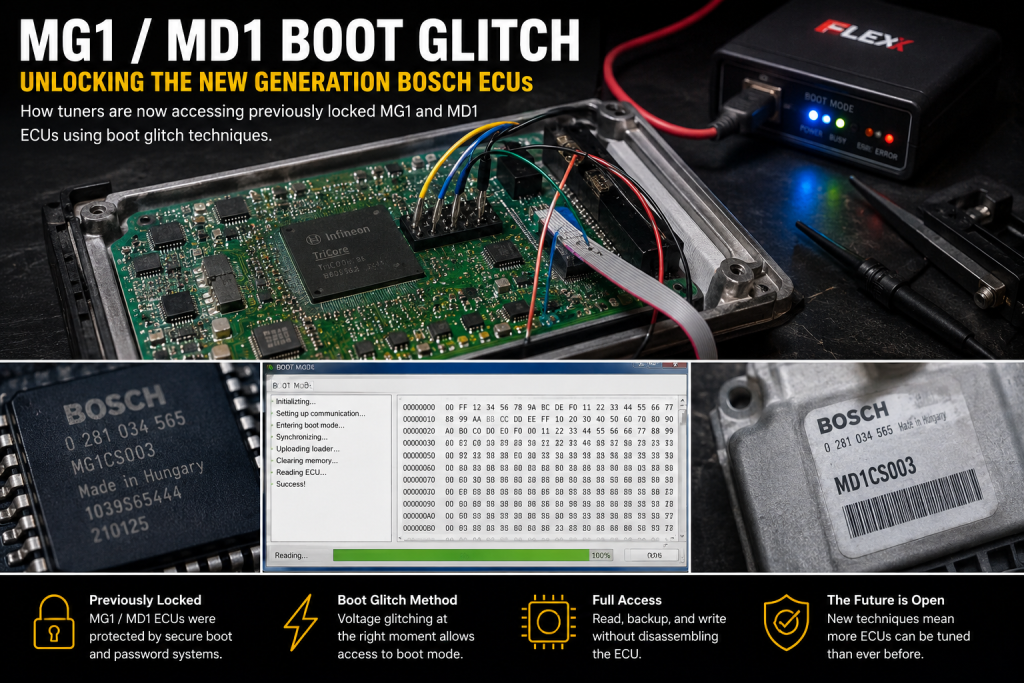
Bosch’s MG1 and MD1 families (petrol and diesel respectively — MG for “Motor Gasoline,” MD for “Motor Diesel”) started replacing the older EDC17 and MED17 generation around 2015-2016, mainly to cope with Euro 6d emissions requirements, more demanding ADAS integration, and the added complexity of hybrid powertrains. Under the hood, most of them run on Infineon’s AURIX TC2xx or TC3xx multi-core processors, with the earliest units built around NXP/ST SPC5777 chips instead. That jump to multi-core silicon is also why flash sizes ballooned from the old single-digit-megabyte EDC17 files up to 4-8MB on these newer units — there’s simply a lot more calibration and logic packed in there now.
For a few years, working on these was business as usual: open the connector, hook up a bench adapter, read and write like you always had. Then, starting around mid-2020, Bosch pushed a firmware change that closed that door. The update added what’s referred to as a CSM — Cyber Security Module — paired with a proper secure boot chain (BMW’s own internal documentation refers to the two halves of that chain as SBOOT and CBOOT). Instead of a traditional, physically accessible boot mode like the old EDC17 had, the newer units were built to only respond through an authenticated factory bench mode or specific OBD protocols that Bosch and the vehicle manufacturer controlled.
The platforms caught up in that mid-2020 change read like a who’s-who of the tuning world’s regular customers: BMW and MINI’s B38, B48, B58, N47, S55 and S63 engines, several Mercedes AMG applications, various VAG 2.0 TDI and TSI units, Ford and Stellantis diesels, even some Kia/Hyundai and Can-Am powertrain applications. And here’s the part that trips a lot of technicians up: the part number on the ECU doesn’t tell you which side of the fence it’s on. An MD1CS004 built in early 2020 might be wide open. The same MD1CS004 reference built a few months later is a brick wall. The only way to know is to try reading it.
If this cat-and-mouse pattern sounds familiar, it should — it’s basically a rerun of what happened with EDC17. Manufacturers locked OBD access, tuners started opening units for physical boot-mode access, and eventually tool makers built “bench mode” workarounds that let technicians pull the internal password through the external connector without cracking the case. MG1/MD1 was Bosch’s attempt to skip straight past that whole cycle by baking real cryptographic verification into the boot process from day one. For about six years, it mostly worked.
The Mail-In Unlock Economy That Grew Around the Lock
Because the lock genuinely worked, an entire service industry sprang up around getting past it — legitimately, through the tool makers themselves, rather than through any kind of workaround.
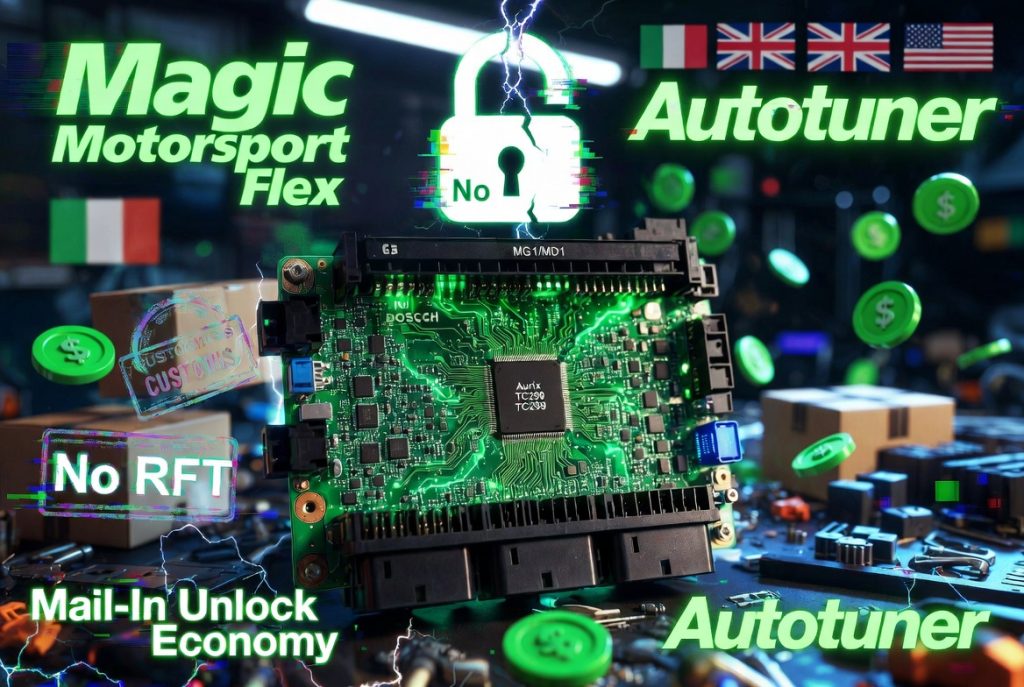
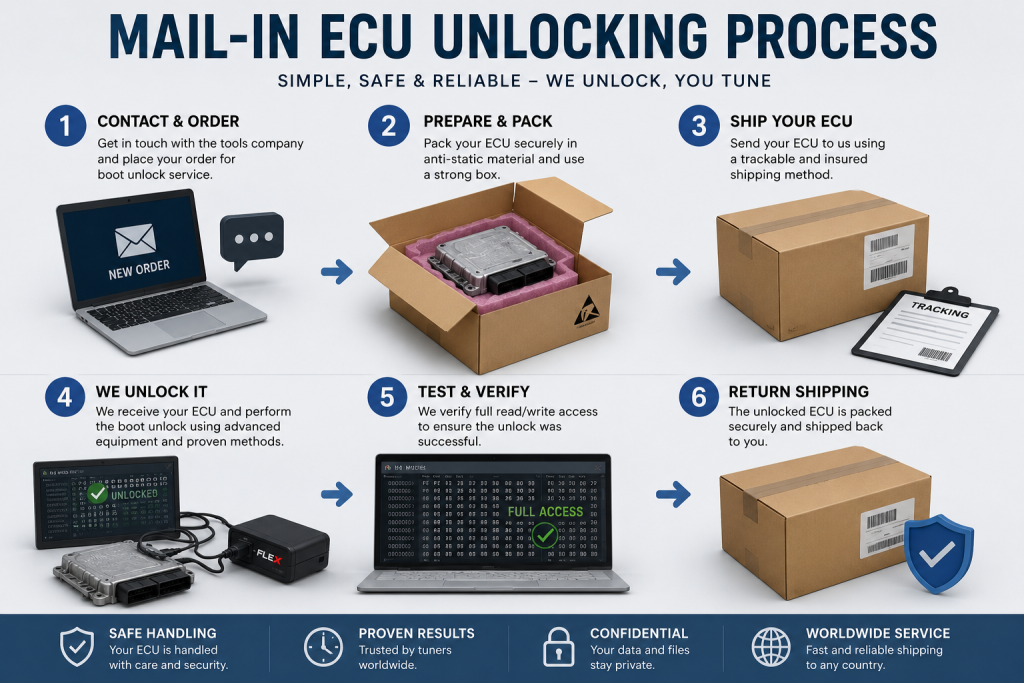
Magic Motorsport built this into their Flex platform as “RFT” — Ready For Tuning. You’d open a support ticket, pack the ECU, and ship it to one of their certified hubs in Italy, the UK, or the US. The unlock itself is billed in “Green Coins,” their internal currency — 150 coins per unit, which works out to somewhere around €690-695 for anyone without a full subscription, though active Master license holders get 300 free coins every month, covering a couple of unlocks. In-house processing typically runs about 48 working hours, plus another two to six days of shipping each way, depending on where you are.
Autotuner runs a parallel model — Remote Unlock and Mail-in Unlock — sometimes bundled automatically into a broader bench workflow, sometimes billed as a flat per-unit fee (€250 was the going rate for one Ford Continental unit last year). Independent regional shops built businesses on the same idea: send us your locked DME, we send it back working, usually inside a business day of it arriving on our bench, for a set service fee.
None of this was unreasonable, exactly — somebody has to do the actual cryptographic legwork, and running certified labs isn’t free. But if you were the workshop stuck in the middle, the pain points were obvious. You had to fully disassemble the ECU, separating the board from the housing, before it could even be shipped. Customs paperwork and duties added cost and delay for anyone outside the destination country — a real headache if you’re running a shop in the Balkans shipping a unit to Italy, for instance. And the clock kept running the whole time: a customer waiting a week for their car isn’t a customer who’s guaranteed to still be your customer by the time it comes back.
So What Does “Glitching” Actually Mean, Technically?
Here’s where the term starts to make sense once you know the background.
“Glitching” — more formally, voltage or fault-injection glitching — isn’t new, and it isn’t unique to cars. It’s a well-documented category of hardware attack that security researchers have used against all kinds of embedded systems for over a decade. The basic idea: every secure boot process has a moment where the processor checks a cryptographic signature before it agrees to run the code sitting in front of it. If everything’s fine, the check passes and the device boots normally. If you can disturb the chip’s power supply — or its clock — for an extremely short, precisely timed window right as that check happens, you can sometimes cause the processor to misread an instruction or skip a step in the verification routine entirely. The chip doesn’t get hacked in the sense of someone cracking the encryption; it just stumbles at exactly the wrong moment and falls through into a mode it was never supposed to hand out.
This isn’t theoretical. The most famous public example is probably the Xbox 360 “reset glitch hack” from around 2011, where hobbyists learned to interrupt the console’s reset line at a specific point during boot to skip a hash check and load unsigned code — no encryption key ever needed. Security researchers have published very similar attacks against all sorts of other hardware since: read-protection downgrades on ST’s STM32 microcontrollers, secure boot bypasses on Espressif’s ESP32, and — closer to home — published research showing the same fault-injection principle defeating boot security on an Nvidia Tegra system-on-chip used in both Tesla’s autopilot hardware and a Mercedes-Benz infotainment platform. The common thread in every one of these cases is the same: secure boot is a strong idea in principle, but the physical moment of checking that signature is a genuinely hard thing to protect against someone with full physical access to the board.
Applied to Bosch’s MG1/MD1 units, “boot glitch unlocking” works on that same principle. Rather than trying to defeat the 256-bit-class encryption Bosch’s marketing likes to point to — which, done properly, is not realistically brute-forceable by anyone — the technique targets the brief, physical moment where the Aurix chip’s boot ROM is validating what it’s about to run. Interrupt that moment correctly, and the chip drops into its unlocked bootloader instead of politely refusing to talk to you. It’s a hardware-level trick, not a codebreaking one, which is exactly why it’s called glitching rather than cracking.
Flex Breaks the Deadlock
Your instinct that Magic Motorsport’s Flex platform got there first lines up with what’s actually been happening. Through most of 2025 and into 2026, RFT stayed the standard route for locked MDG1 units — “MDG1” being the shorthand the industry uses when talking about MD1 and MG1 together, since the lock and the unlock methods largely overlap between the two families.
That changed at the very end of June 2026, when Magic Motorsport rolled out what they’re calling boot glitch unlocking for Bosch MDG1 units built around the Aurix TC2xx processor — directly in the workshop, with no RFT ticket and no shipping involved. The connection runs through the Flex kit’s port E, using the included FLX4.1 adapter, and the unit needs to be fully out of the car and set up on a bench rig the same way any other bench job would be. Once the glitch unlock completes, the ECU behaves like any unlocked bench job from that point on — normal read and write, normal tuning workflow, no repeat unlock needed for future sessions.
Coverage on day one focused on specific MD1 references — MD1CS003 and MD1CS004 among them — across VAG, BMW/MINI, Stellantis (the old FCA/PSA combination), Kia/Hyundai and JLR applications, with Magic Motorsport adding more variants in the weeks since. Within days, workshops were already posting real results: a BMW-fitted MD1CS003 taken through the glitch procedure, read and written cleanly on the bench afterward, engine started and ran with no drama. Not every locked variant is covered yet — MD1CS104, MD1CS001 and MD1CP001 are still sitting on the “not yet, but coming” list — and TC3xx-based units, the newer and more capable chip in the same family, haven’t been cracked this way either. But for a method that’s only a few weeks old at the time of writing, the coverage list is moving fast.
How the Rest of the Market Is Reacting
Nobody in this industry sits still when a competitor changes the rules, and the reaction here has been predictably immediate. Technicians who’d been paying RFT fees for months started publicly hoping Autotuner would ship its own boot-mode solution rather than stick with mail-in and remote unlock pricing. Alientech’s KESS3 has been pursuing a different philosophy entirely — a “virtual read” over OBD that sidesteps the bootloader question altogether rather than attacking it directly, giving shops a second route that doesn’t depend on physical glitching at all. BitBox, running on Scanmatik hardware, has been shipping its own Gen2 bench modules aimed at specific locked variants, Ford units among the first, through its SM3 adapter line.
It’s worth remembering that before any boot-mode access existed for these units, there wasn’t even a proper recovery path if one got bricked mid-job — workshop forums have threads full of technicians asking, half-seriously, whether the only way to learn recovery was to intentionally kill one and figure it out from there. A working boot-mode connection doesn’t just open tuning access; it gives shops an actual safety net for units that go wrong during a write.
What This Actually Changes on the Shop Floor
Strip away the marketing language and the practical shift is simple: turnaround for these units drops from the better part of a week to whatever a normal bench session takes — minutes, not days. No opening a case to ship a bare board across a border, no customs paperwork, no shipping insurance, no explaining to a customer why their car is sitting for a week waiting on a parcel. For shops outside whichever country hosts the nearest certified hub, that alone removes a genuine competitive disadvantage.
It also puts real pressure on the unlock-as-a-service side of the business. RFT and its equivalents aren’t going away — there will always be units, chip revisions, and edge cases the glitch method doesn’t reach yet — but a workshop that no longer needs to buy Green Coins or pay a flat per-unit fee for the models that are covered has one less recurring cost to plan around. Expect other tool makers to move quickly toward their own in-house solutions rather than cede that ground.
The Catch — What Glitch Unlock Doesn’t Solve Yet
None of this makes MG1/MD1 an open book overnight, and it’s worth being honest about the limits.
Coverage is still partial and tied to specific ECU references, specific processor families, and in some cases specific hardware or software revisions within the same part number — remember, you can’t tell a locked unit from an unlocked one just by looking at it. Success on one variant doesn’t guarantee success on the next one Bosch ships, and there’s nothing stopping Bosch from pushing another firmware revision that closes this particular window the same way the mid-2020 update closed the one before it. This entire field moves in cycles, and there’s no reason to assume this one is the last.
There’s also a broader regulatory current pushing in the opposite direction of everything this article just described. Vehicle cybersecurity type-approval rules — UNECE R155 being the big one in Europe — are pushing manufacturers across the board to harden secure boot and access control on their control units, not loosen it. Bosch’s MG1/MD1 lock wasn’t an isolated decision; Ford’s heavily encrypted Continental/Vitesco SID212 unit went through the same kind of tightening around the same period, for the same underlying reasons. Expect this pattern — lock, mail-in workaround, eventual glitch or bypass, re-lock — to keep repeating across other ECU families as the regulatory pressure keeps building.
And the standard caveats that apply to any ECU modification still apply here: altering certified calibration can affect emissions compliance and typically voids whatever warranty coverage remains, and the legality of bypassing manufacturer security measures for tuning purposes varies significantly by country and by whether the vehicle is used on public roads or off-road/competition only. None of that is unique to glitch unlocking — it’s the same set of considerations that’s applied to ECU tuning generally for years — but it’s worth keeping in mind before treating “we can unlock it now” as the end of the conversation with a customer.
Quick Answers: What Is Glitch Unlock?
What is glitch unlock, in one sentence? It’s a hardware technique that briefly disturbs an ECU’s power supply at the exact moment its secure boot process is checking a cryptographic signature, causing the chip to skip that check and drop into an unlocked bootloader mode instead of refusing access.
Which ECUs does it currently work on? As of mid-2026, it’s rolling out for Bosch MDG1 (MD1/MG1) units built on the Infineon Aurix TC2xx processor, across VAG, BMW/MINI, Stellantis, Kia/Hyundai and JLR applications — with coverage expanding model by model.
Who released it first? Magic Motorsport, through its Flex platform, was first to ship an in-workshop boot glitch solution for these units, at the end of June 2026, replacing the mail-in RFT process for the models it supports.
Does this replace bench mode? No — glitch unlock gets you past the boot-level lock so the unit can then be read and written normally in bench mode. It’s a step before the usual workflow, not a replacement for it.
Will this get patched? Almost certainly, for at least some variants, over time. Manufacturers have hardened these boot chains before and have every regulatory incentive to keep doing it. Treat current coverage as a moving target rather than a permanent fix.
Where This Leaves Things
Three years is a long time for a lock to hold in this industry, and MG1/MD1’s Cyber Security Module held up longer than most. What changed this summer isn’t that the encryption got weaker — it’s that someone found the physical seam in the process instead, the same way researchers have found similar seams in game consoles, microcontrollers, and other automotive silicon before. Whether the rest of the tool makers catch up in weeks or months, and whether Bosch answers with another hardening pass, is the part worth watching next. For now, for a growing list of post-2020 units, the box no longer needs to leave the workshop.



No connection to md1cs006 with flex , fails on 20% every time. Tried shorter connection , 5omh resistor and nothing works? Any solution?