 ECU Datasheet 2.0 - Comprehensive ECU Repair Reference
 Subtotal: $18
Car ECU Repair and Datasheets: From Burnt Drivers to Boot Mode Reads Leave a comment
When you spend enough years around cars, one thing becomes obvious: ECUs fail more often than people think, and when they do, the average driver gets a shock. Imagine walking into a dealership and being told your car won’t start because the ECU is dead, and the new unit will cost you over a thousand euros plus programming. Most people don’t even have that kind of money set aside, and this is exactly where the world of ECU repair has grown into its own industry. Instead of throwing away the whole unit, a good technician can open it, trace the fault, and bring it back to life for a fraction of the cost. And honestly, there’s something satisfying about reviving a piece of electronics that was considered “dead” by everyone else.
What ECU Repair Really Means
A lot of people confuse ECU repair with tuning, but the two are completely different animals. Flashing in a new map for more horsepower doesn’t fix a non-start issue or a blown injector driver. Real ECU repair is more like surgery. You’re dealing with electronics that handle power distribution, injector timing, immobilizer data, and dozens of signals that keep the engine running smoothly. When one small part of that chain fails, the whole car can come to a stop.
For example, I once had a Peugeot with a Bosch EDC16 ECU that had gone completely dead after a short on the wiring loom. A quick test showed that the 5V line wasn’t present. Inside the ECU, the regulator responsible for that voltage rail had literally burned a hole through its casing. Replacing that tiny part — a job that costs a few euros in components and half an hour of bench time — saved the customer from spending over a thousand euros. That’s the essence of ECU repair: understanding the system enough to track down the weak link and fix it, instead of replacing the whole thing.
The Importance of Good Tools
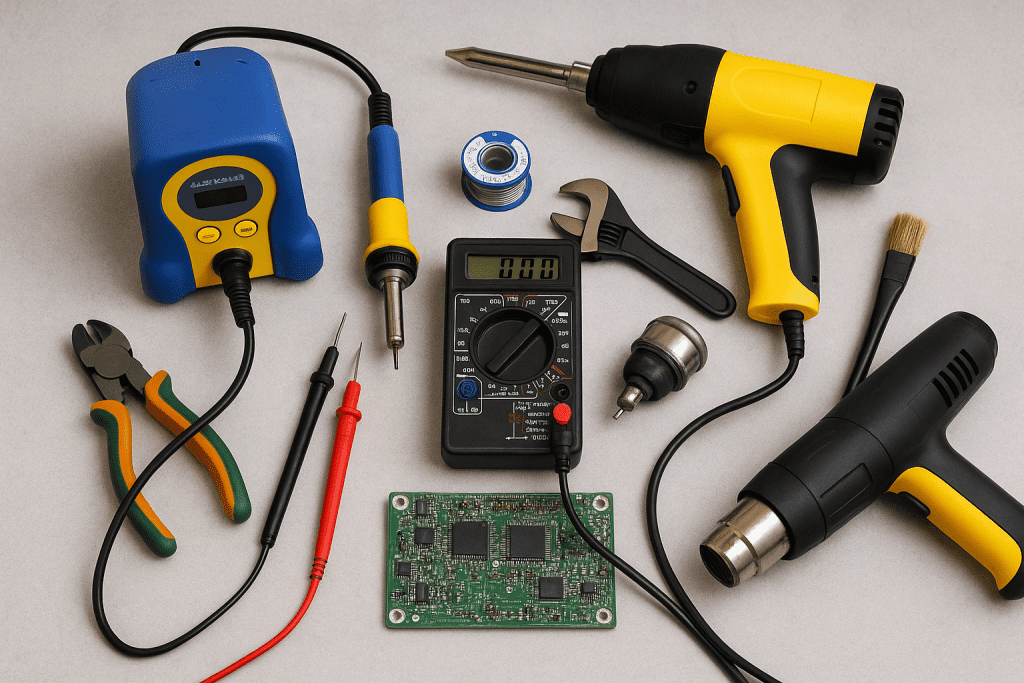
If you’re serious about ECU work, tools are not optional. I’ve seen plenty of beginners try to tackle repairs with a cheap soldering iron and no magnification, and the result is usually lifted pads, fried tracks, or worse — a completely destroyed board. A stable soldering station with temperature control is not a luxury; it’s the difference between making a clean joint and cooking a microchip. Add a hot air station, a good microscope, and a reliable bench power supply, and suddenly your success rate goes up dramatically.
On the software side, proper ECU programmers are just as vital. Reading and writing Tricore processors, for example, can’t be done with some €20 USB gadget from eBay. You need gear like KTAG, Autotuner, or Flex that not only handle the communication protocols but also manage power sequencing properly. Without that, you risk bricking the ECU permanently. I’ve lost count of how many units I’ve had to unbrick for people who tried to save money on tools. In the end, they spend more fixing their mistakes than if they’d bought the right equipment in the first place.
Datasheets – The Technician’s Secret Weapon
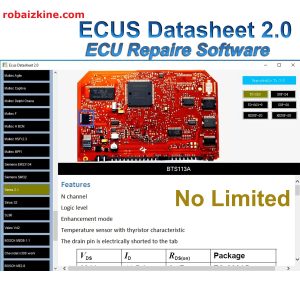
One of the most underrated skills in ECU repair is learning to actually read datasheets.When you open up a board and see a burnt chip, the only way to know what it does, how it fails, and what you can replace it with is through its datasheet. I once had a Ford SID310 where two injector drivers had blown because of shorted injectors. Without the datasheet, those chips just look like random black rectangles with legs. With the datasheet, you know which pins are input, output, ground, and supply, and you immediately know how to test them with a multi meter.
Sometimes datasheets even save the day when replacement parts aren’t available. I had a case where the exact driver IC was obsolete, but the datasheet showed in ecu datasheet 2.0 app the electrical parameters. By cross-referencing those, I found a compatible modern chip that fit the role perfectly. The car started up fine, and the customer had no idea that the heart of his ECU was running on a substitute part. This is the kind of detail that separates real repair technicians from parts swappers.
ECU Families and Their Quirks
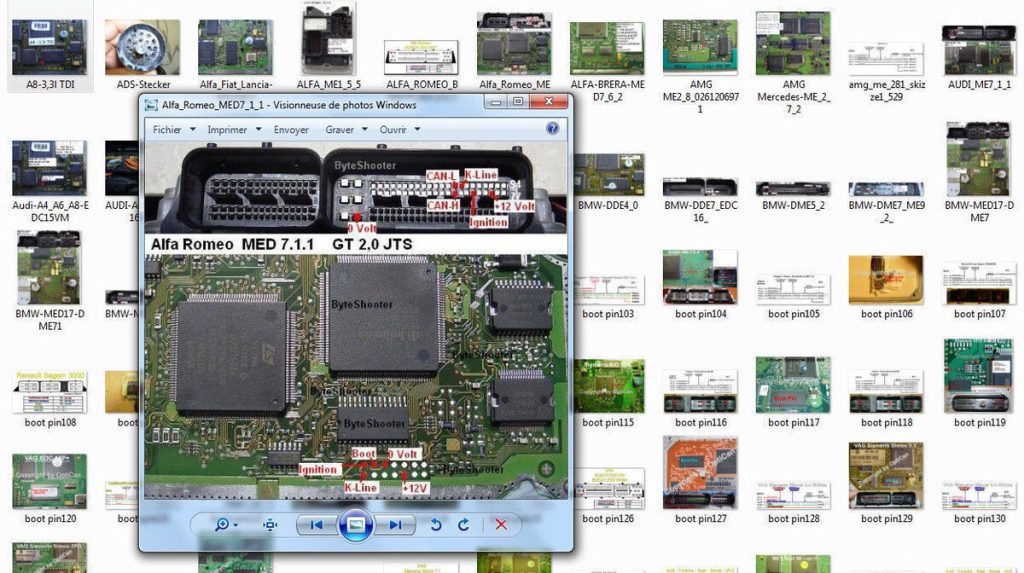
Every ECU family has its own reputation, and after a while, you recognize them by their faults. Bosch EDC16 units are generally solid but often come in with burnt injector drivers or corrupted EEPROMs. They’re a good starting point for beginners because the hardware is relatively forgiving, and replacement parts are widely available. EDC17 units, on the other hand, are a different beast. With Tricore processors and security protection, you almost always end up in boot mode when repairing them. I had a BMW EDC17C50 that refused to communicate via OBD, and the only way in was through boot mode with KTAG. After cloning the original data into a donor ECU, the car fired up instantly. It’s satisfying, but it takes more skill than the older units.
PCR2.1 ECUs, used in VW 1.6 TDI engines, are notorious for frustrating both DIYers and professionals. They lock down the EEPROM so hard that you have no choice but to go through boot mode, and one slip in the process can brick the unit for good. I’ve had more of these on my desk for recovery than any other ECU type. SID 309 and 310 ECUs in Ford and PSA vehicles are another headache because injector shorts often kill the drivers. Unless you replace the bad injector as well, the ECU will come back on your bench in a week. And then there are Denso units — especially in Toyota pickups — that love to corrode. You open them up and the PCB looks like it’s been sitting at the bottom of a river. Cleaning those boards, rebuilding the tracks with fine wires, and sealing them again is messy work, but when the engine roars back to life, it makes it worth it.
Hardware vs Software Repairs
Not every repair is about soldering. Sometimes the ECU hardware is fine, but the software inside it has become corrupted. This is where knowledge of memory structures comes into play. EEPROM holds immobilizer and coding data, while the Flash memory contains the maps and firmware. If either gets corrupted, the ECU may refuse to start the engine. A common trick is to take the EEPROM from the dead ECU and transplant it into a donor. That way, the car accepts the donor ECU without complaining about immobilizer mismatches.
Then you’ve got the world of boot mode and bench mode. Boot mode means opening the ECU, grounding the boot pin, and forcing the processor into a state where you can read or write its memory directly. Bench mode is a bit safer, letting you communicate with the ECU on the desk without opening it, though not all ECUs support this. I remember a Golf with an EDC17 where the only option was boot mode. The soldering was delicate, the procedure was nerve-wracking, but when the clone finally completed and the engine started, it felt like magic.
The Business Side of ECU Repair
From the outside, ECU repair looks like pure electronics, but anyone running a shop knows it’s also about trust and time. Customers don’t want long explanations about burnt MOSFETs; they want their car back as soon as possible and for a reasonable price. If you can repair a €1000 ECU for €200 and get the car back on the road in two days, you’ll not only have a happy customer, but also repeat business and referrals. Word spreads fast, and in this line of work, your reputation is worth more than any advertising budget.
There’s also the balance between transparency and professionalism. Some technicians hide their methods, but I’ve found that explaining the basics to a customer — without drowning them in technical jargon — builds trust. Telling them that “your ECU had a shorted driver because of a bad injector, we replaced the driver and recommend replacing that injector too” is much better than just saying “it’s fixed.” That trust is what keeps customers coming back, and it’s why ECU repair has become not just a technical trade, but a viable business model.
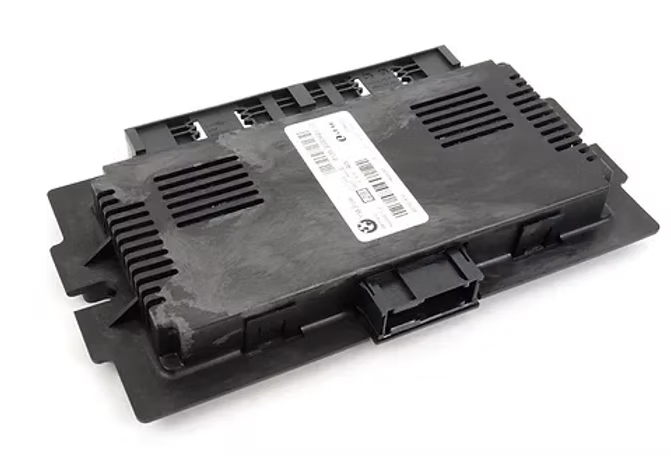
Not just engine ECUs are prone to go bad — for example, BMW’s FRM (Footwell Module) is a classic case. It often fails after a flat battery or bad jump-start, leaving the car without lights, window control, or mirror functionz.What usually happens is the FRM loses comunication and all the lighting functions stop, windows no longer move, and diagnostics can’t read the module. In most cases the hardware is fine — the issue is corrupted EEPROM data inside the 95128 chip. A common fix is to remove the module, open the casing, locate the EEPROM, and either reflash it with a known good dump or repair the corrupted data. Some techs desolder and program it with a dedicated programmer, while others use in-circuit readers like Xprog or Orange5. The repair is often quicker and cheaper than replacing the entire module, and once the data is restored, the FRM usually comes back to life without further coding. Some of example bmw frm repairs you can learn in separate blog post.
Wrapping Up
ECU repair isn’t easy, but it’s rewarding in ways that go beyond money. There’s a real sense of accomplishment in taking a lifeless board and bringing it back, knowing that you saved someone from a huge bill and kept their car on the road. It’s a mix of detective work, electronics, and patience. For beginners, starting with simpler units like Bosch EDC16 is the best way to learn. For professionals, investing in the right tools and constantly practicing on newer models is the only way to stay ahead.
Every ECU that comes across your bench tells a story. Some stories are quick — a burnt regulator swapped in an hour. Others take days of tracing circuits, reading datasheets, and sweating over a boot mode recovery. But every single one makes you a better technician. And at the end of the day, that’s what keeps this field alive: the challenge, the learning, and the satisfaction of solving problems others couldn’t.