
Bin God – One Platform for ECU, EEPROM, Airbag and Automotive File Work 2
Anyone who works daily with automotive electronics knows how scattered the workflow still is.
One contact for ECU tuning.
Another for EEPROM jobs.
Someone else for airbag crash reset.
Another source for mileage correction.
And when a radio locks or an ECU gets corupted, you start searching again.
It wastes time. It costs money.And results are inconsistent depending on who you send the file to.
Bin God was built to remove that problem.
The main site at https://bingod.app/ and the working portal at https://portal.bingod.app/ are designed as a single place where all common automotive file services can be handled in a structured way, without jumping between different providers.
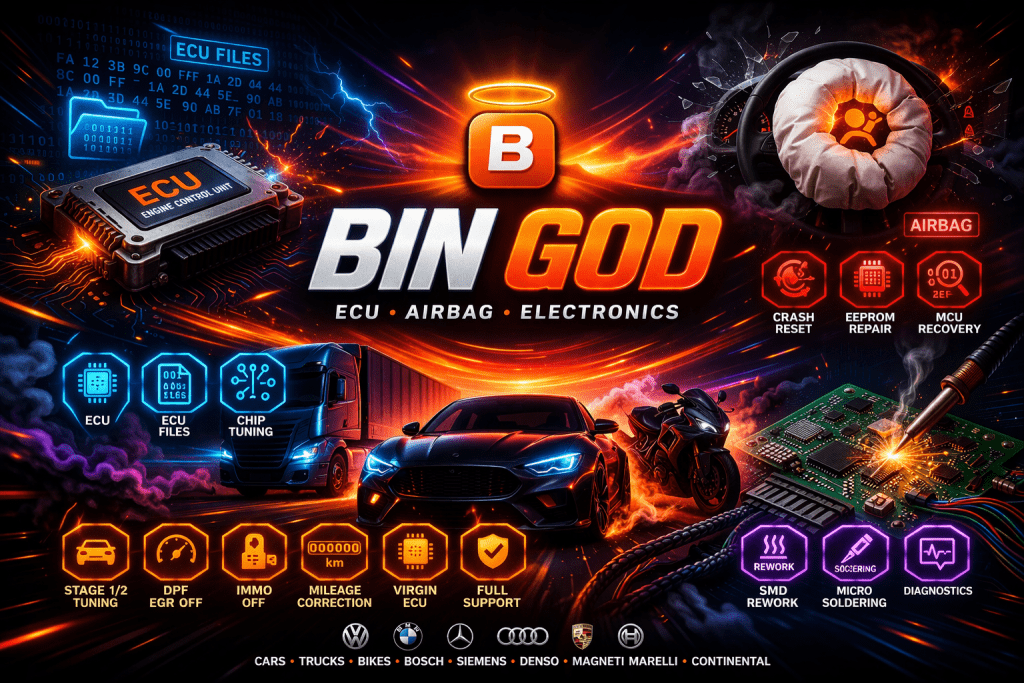
Built from Actual Workshop Workflow
This is not a generic platform made around theory.
It reflects how real jobs come into a workshop:
- Car arrives with multiple faults
- ECU needs modification or correction
- Airbag module locked after crash
- Mileage mismatch between modules
- Immobilizer issue after replacement
- Radio asking for code
These are not isolated tasks. They often come together on the same vehicle.
That’s exactly why the platform is built as an all-in-one environment.
50% PROMOTION ON BIN GOD CREDITS
ECU File Modifications – Real Work, Not One-Click
ECU file work is the core of most automotive electronics jobs today.
Typical requests include:
- Stage 1 tuning
- DPF, EGR, AdBlue solutions
- DTC-related corrections
- Torque and drivability adjustments
- Original file recovery
Modern ECUs are not simple anymore. You are not just increasing fuel or boost.
Everything is torque-based:
- Driver demand maps
- Torque limiters
- Boost control
- Smoke limitation
- Temperature protection
If these are not aligned properly, the result is unstable.
That’s why proper file handling matters. Not just running a file through automated software, but understanding how the ECU actually works and how changes interact.
EEPROM and MCU Work – Where Many Jobs Actually Sit
A large part of real workshop work doesn’t even involve ECU flash.
It’s inside EEPROM or MCU memory.
Typical cases:
- Mileage storage
- Immobilizer data
- Module configuration
- Airbag crash data
- Radio codes
EEPROM work requires accuracy. Data is often stored in multiple locations, sometimes mirrored, sometimes encoded.
If only one part is changed, the system can revert or create inconsistencies.
MCU-based modules are even more sensitive. Wrong modification can make the module unusable.
Airbag Crash Data Reset – One of the Most Common Requests
Airbag modules lock themselves after a crash event.
Even if all physical components are replaced, the module still stores crash data and stays in locked state.
Inside the file, you usually have:
- Crash flags
- Deployment records
- Event history
- Internal counters
Resetting this correctly means:
- Removing crash data
- Keeping coding intact
- Maintaining communication
- Avoiding new fault generation
This is not something you guess. Each module has its own structure.
A wrong edit can completely kill the unit.
That’s why many workshops rely on external file service for this type of work.
Mileage Correction – Multi-Module Reality
Mileage is no longer stored in one place.
Depending on the vehicle, it can be found in:
- Dashboard cluster
- ABS module (very common in Renault)
- BSI / BCM (Peugeot, Citroën and others)
- ECU backup values
The important part is not just changing the value.
It’s understanding:
- Which module is master
- Which modules sync automatically
- How data is structured
If done incorrectly, mileage will revert or create mismatches between modules.
Radio PIN Code Decoding
Still one of the most frequent small jobs.
After battery disconnect or unit replacement, the radio locks and requires a code.
Depending on the system, the code is:
- Stored in EEPROM
- Derived from serial
- Encoded in specific memory structure
Decoding requires proper file read and correct interpretation.
Simple when you know the structure. Not so simple without it.
Why One Portal Matters
The main difference with Bin God is not just the services themselves.
It’s how everything is organized.
Instead of:
- Messaging multiple providers
- Waiting for replies
- Sending files in different formats
- Losing track of jobs
Everything goes through a single structured workflow.
How the Portal Works
Inside https://portal.bingod.app the process is straightforward:
- Upload your file
- Select the required service
- Open a ticket
- Receive processed file
All communication stays inside the ticket.
No confusion. No lost files. No mixed conversations.
For workshops handling multiple jobs per day, this alone saves a lot of time.
Pricing – Keeping It Realistic
One of the biggest issues in the file service market is pricing.
Costs often go up depending on:
- Provider
- Region
- Type of job
- Urgency
Bin God takes a different approach.
Most standard jobs are around 15€, depending on complexity.
The idea is simple:
Keep it accessible for daily workshop use, not just occasional jobs.
Designed for People Who Actually Do This Work
This is not aimed at casual users.
It’s built for:
- Tuners
- Mechanics
- Automotive electricians
- Dashboard repair specialists
- Airbag repair technicians
- Workshops dealing with ECU and EEPROM files daily
People who understand what they are working with and need reliable support.
The Goal Behind Bin God
The goal is not to create another file service.
It’s to build a central place for automotive binary work where different types of jobs can be handled without switching systems, providers, or workflows.
ECU tuning, EEPROM editing, airbag reset, mileage correction, radio decoding — all in one place, handled properly.
Final Thought
Most workshops don’t struggle with tools.
They struggle with consistency, time, and reliable file handling.
That’s exactly what Bin God is trying to fix.
One portal. Real file work. No unnecessary complexity.
Join Bin GOD now on https://bingod.app


Best file service in world by far!!!!
best portal for tuning, i tried on ford ranger v6 for dpf off and stage 1 and great results